


DOT Urine Specimen Collector Training Online
Complete your DOT urine specimen collector qualification training and 5 mock collections in one course. Supplies are included if needed.
No surprise add-on fees.
Includes training, mock collections, and supplies if needed.
- Trusted by 28,000 medical professionals
- Mock collections included
- Mock collection supplies included if needed
- Certificate after successful completion
What’s Included in the $299 Price?

Qualification Training
2 training videos (89 mins total) provide an in-depth discussion of everything a specimen collector should know

Proficiency Demonstration
5 mock collections performed via video conference
Mock Collection Supplies
Supplies mailed if needed for your mock collections
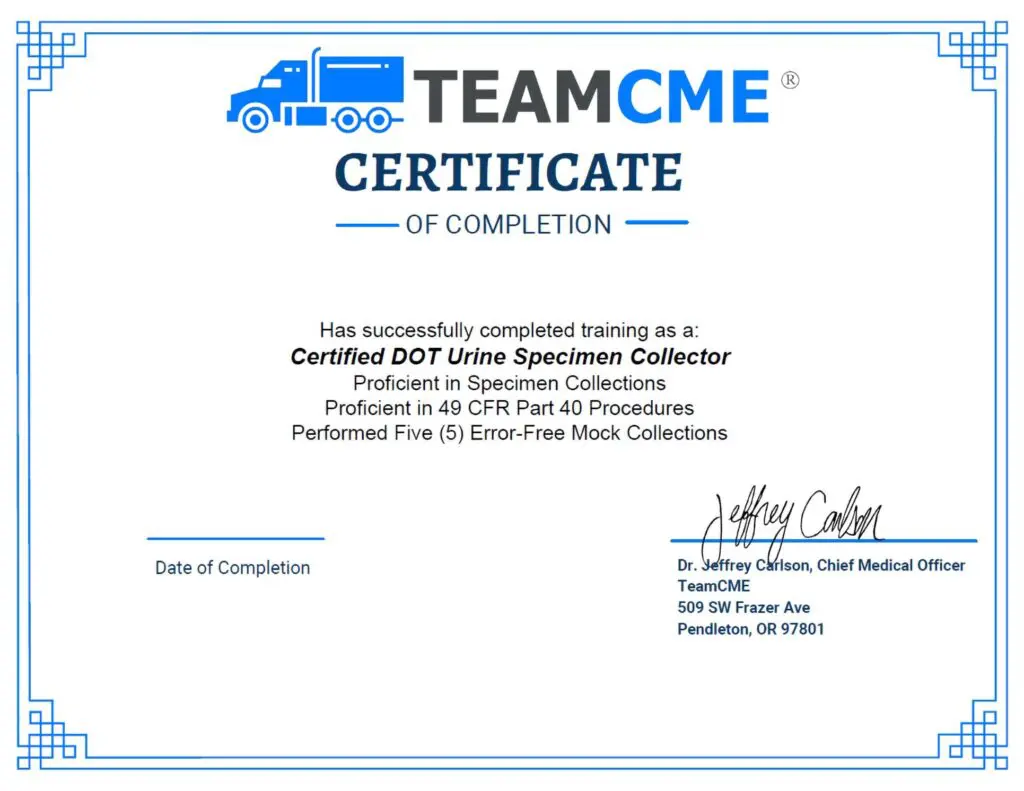
Certificate of Completion
Available upon review of your completed CCFs from the mock collections
Avoid Surpise Add-On Fees
Some DOT collector courses advertise a low upfront price, but required mock collections, supplies, or proficiency demonstration fees may cost extra. TeamCME includes the qualification training, 5 mock collections, and supplies if needed in one transparent price.
| Feature |  | Some Lower-Priced Courses |
|---|---|---|
| Online qualification training | Included | Usually included |
| 5 mock collections | Included | May cost extra |
| Supplies if needed | Included | May cost extra |
| Downloadable manual | Included | Varies |
| Certificate after successful completion | Included | Varies |
| Group registration help | Available | Varies |
Training 3 or More Collectors? Ask About Group Pricing
Need to train several staff members at the same clinic, company, or organization? TeamCME offers group registration for clinics and teams registering 3 or more students for DOT urine specimen collector training.
Who This Course is For
This course is designed for individuals and organizations that need DOT urine specimen collector training, including:
- New collectors needing DOT drug test training & mock collections
- Existing collectors needing 5-year requalification training
- Clinics adding DOT drug testing services
- Occupational health clinics training staff members
- Mobile drug testing businesses
- Employers who want in-house staff trained to perform collections
How it Works
Complete your DOT urine specimen collector training in 5 simple steps.
1. Register Online
Enroll in the course and get access to the online training materials.
2. Complete the Training Videos
Watch the self-paced qualification training videos on your schedule.
3. Pass the Quiz
Complete the 32-question quiz. You may retake it as needed to pass with 80% or higher.
4. Schedule Your Mock Collections
After passing the quiz, schedule your live video proficiency demonstration.
5. Receive Your Certificate
Your certificate is issued after successful completion of the training, quiz, 5 mock collections, and document review.
Ready to get started?
What You’ll Learn
Learn the essential procedures and compliance requirements for performing DOT urine specimen collections, including:
- Proper specimen collection procedures
- Maintaining the integrity of the specimen
- How to properly complete a chain of custody (CCF)
- Legal and ethical considerations
- Proper observation and monitoring techniques
- Confidentiality and privacy considerations
Curriculum
There are 2 video modules in this course, 1 quiz, and a proficiency demonstration (mock collections)
Video Module One – 52 minutes
Introduction to Certification
- Overview of training requirements:
- Initial training
- Five-year recertification
- Error-correction training
- Certification achieved upon:
- Completion of online training.
- Proficiency demonstration (within 30 days).
- Reference to the latest DOT Urine Specimen Collection Guidelines.
DOT Overview and Safety Goals
- Importance of DOT audits and undercover reviews.
- DOT’s safety priorities:
- Ensuring 100% drug- and alcohol-free transportation operators.
- Regulatory authorities under DOT:
- FAA, FMCSA, FRA, FTA, PHMSA, and USCG (Homeland Security).
Role of the Certified DOT Urine Specimen Collector
- Responsibilities:
- Maintaining the integrity of the collection process.
- Ensuring donor privacy.
- Completing Federal Drug Testing Custody and Control Form (CCF).
- Qualifications per 49 CFR Part 40.33.
Training and Proficiency Requirements
- Qualification Training:
- Topics: proper procedures, shy bladder scenarios, tampering detection, and fatal flaws.
- Proficiency Demonstration:
- Five error-free mock collections.
- Recertification Training:
- Required every five years.
- Error Correction Training:
- Addressing collection errors.
DOT-Required Drug Testing Situations
- Types of Testing:
- Pre-employment
- Post-accident
- Random
- Reasonable suspicion
- Return-to-duty
- Follow-up
- Specific guidelines for each type
Collection Site and Security Requirements
- Acceptable facilities:
- Single-toilet or multi-stall restrooms.
- Security measures:
- Preventing access to adulteration agents.
- Use of bluing agents.
- Ensuring donor privacy and preventing unauthorized access
Step-by-Step Collection Process
- Preparing the site:
- Ensuring availability of required supplies.
- Initial steps:
- Collector and donor identification.
- Explanation of the process.
- Collection procedure:
- Handling shy bladder scenarios.
- Inspecting and sealing specimens.
- Final steps:
- Completing and distributing CCF copies.
- Packaging and shipping specimens to laboratories
Federal Drug Testing Custody and Control Form (CCF)
- Parts of the CCF:
- Test facility copy
- MRO copy
- Collector copy
- Employer copy
- Employee copy
- Importance of accuracy and completeness
Shy Bladder Protocol
- Definition and management:
- Providing fluids within three hours.
- Noting all attempts and actions on the CCF.
- Consequences of insufficient specimen
Specimen Handling and Transport
- Ensuring specimen integrity:
- Proper sealing and labeling.
- Secure transport to laboratories.
- Documentation retention requirements
Common Errors and Fatal Flaws
- Examples of errors:
- Incorrect temperature readings.
- Improper sealing of specimen bottles.
- Corrective procedures and retraining requirements
Ethical and Professional Conduct
- Avoiding conflicts of interest.
- Ensuring respect and privacy for donors.
- Maintaining professionalism throughout the process
Key Updates in DOT Drug Testing
- Expanded drug panels as of 2018:
- THC, cocaine, opioids, amphetamines, etc.
- Emphasis on random selection processes
Video Module Two – 37 minutes
Directly Observed Collection
- Definition: Observer watches urine go from donor’s body into the collection container.
- Conditions requiring observed collection:
- Invalid specimens.
- Negative-dilute results with creatinine levels between 2-5 mg/dL.
- Return-to-duty and follow-up tests.
- Suspected tampering or out-of-range temperatures.
- Observer protocols:
- Must be the same gender as the donor.
- Avoids physical contact; ensures visual observation.
- Documentation on CCF, including observer’s name and reason for observation.
Addressing Tampering and Substitution
- Identification of tampering devices:
- Prosthetics, concealed containers, synthetic urine kits.
- Response protocols:
- Immediate observed recollection.
- Noting tampering details on CCF and notifying DER.
- Tools for detection:
- Observation of donor behavior.
- Inspection of unusual specimen characteristics (e.g., color, odor).
Monitored Collection Protocol
- Definition: Conducted under less-than-private conditions (e.g., multi-stall restrooms).
- Key points:
- Monitor ensures donor hands container directly to collector.
- Same-gender monitor requirement unless they are a medical professional.
- Monitored collections require thorough documentation
Special Medical Considerations
- Catheterization:
- DOT tests cannot be collected via catheterization unless the donor self-catheterizes
- External urine bags:
- Procedures for fresh voided samples.
- Privacy considerations for donors using medical devices.
- Adherence to regulatory guidelines:
- Collectors must ensure respect and privacy for medically sensitive cases.
Temperature and Volume Checks
- Temperature requirements:
- Acceptable range: 90° to 100°F.
- Procedures for out-of-range specimens:
- Immediate observed recollection.
- Documentation on both original and new CCFs.
- Volume requirements:
- Minimum: 45 mL.
- Insufficient specimens initiate shy bladder procedures.
Shy Bladder Protocol
- Defined as the inability to provide a sufficient specimen (45 mL).
- Procedures:
- Donor offered up to 40 ounces of fluid over 3 hours.
- Collection ends if no specimen is provided within 3 hours.
- Documentation:
- Detailed notes on attempts and actions on CCF.
Error and Flaw Management
- Correctable Flaws:
- Errors like incomplete forms, missing dates, or incorrect temperature recording.
- Corrected through written statements and documentation.
- Fatal Flaws:
- Irreparable issues (e.g., broken seals, mismatched CCF numbers).
- Requires error correction training within 30 days.
- Proactive documentation to prevent errors.
Roles of the Medical Review Officer (MRO)
- Responsibilities:
- Verify and interpret test results.
- Ensure donors have opportunities to explain positive results.
- Communicate results confidentially to employers.
- Split specimen testing:
- Process for donor-initiated retesting at independent labs.
Industry-Specific Regulations
- FMCSA (Truck Drivers):
- Testing for CDL holders and hazardous material transporters.
- Post-accident testing criteria:
- Fatalities, injuries, vehicle towing, or citations.
- FAA (Aviation):
- Covered employees: flight crew, maintenance staff, etc.
- Testing after accidents involving fatalities or substantial damage.
- FRA (Railroads):
- Covered employees: train crew, dispatchers, signalmen.
- Post-accident testing includes urine and blood samples.
- FTA (Transit):
- Testing after accidents with fatalities or disabling damage.
- Supervisor training for drug and alcohol indicators.
- USCG (Maritime):
- Testing required for serious marine incidents (SMI).
- Results reported to Coast Guard authorities.
Laboratory-Based vs. Rapid Testing
- Lab-based testing:
- Gold standard for DOT drug tests.
- Confirmation tests with mass spectrometry or gas chromatography.
- Rapid tests (Non-DOT):
- On-site presumptive positives.
- Confirmation testing suggested to avoid false positives
Steps for DOT-Compliant Collections
- Overview of 10 critical steps for secure collections:
- Picture ID verification.
- Securing the collection site.
- Inspecting and securing specimen and paperwork.
- Importance of maintaining control over the collection process.
Specimen Collector Quiz – 32 questions
The quiz can be taken as many times as needed to pass with an 80% or higher.
Proficiency Demonstration (5 Mock Collections) – 90 minutes
Students can schedule a time through our online scheduling platform located within the proficiency lesson. This lesson is accessible upon completion of the quiz. It is performed via live video conference. Please contact us for larger groups.
Built by DOT Compliance Training Experts
TeamCME has trained medical professionals nationwide in DOT compliance, including NRCME medical examiner training and drug and alcohol testing education. Our training programs are developed with a practical understanding of DOT procedures, documentation, and compliance expectations.
TeamCME founder Dr. Michael Megehee has been training medical professionals to perform DOT compliance services since 1996. In fact, he was selected by the Federal Motor Carrier Safety Administration (FMCSA), an agency of the DOT, as a subject matter experts who helped design training curriculum.
Dr. Jeff Carlson, TeamCME’s Chief Medical Officer, co-developed this course and leads the development of TeamCME’s training programs. He has published on DOT medical compliance and has trained medical professionals nationwide through live seminars.

FAQs
What is included in the $299 DOT specimen collector training?
The $299 course includes DOT urine specimen collector qualification training, a downloadable training manual, a quiz, 5 mock collections completed by live video conference, and a certificate of completion after your mock collection documents are reviewed and approved. Collection supplies are also included if needed.
Are mock collections included?
Yes. The course includes the required 5 mock collections, also called the proficiency demonstration. These are completed by live video conference after you finish the training videos and pass the quiz.
Are collection supplies included?
Yes. If you need supplies for your mock collections, TeamCME will mail collection kits to you. This helps you complete the mock collection portion of the training without having to find supplies on your own.
How are the 5 mock collections completed?
After completing the training videos and passing the quiz, you can schedule your mock collections through our online scheduling system. The mock collections are completed by live video conference. During the session, you will demonstrate the collection process and complete the required paperwork for review
How long does the course take?
The video training portion is approximately 89 minutes. The quiz has 32 questions, and the proficiency demonstration with 5 mock collections typically takes about 90 minutes. The total time may vary depending on scheduling and how long it takes to complete the mock collection review process.
Can I complete the training at my own pace?
Yes. The course and all its content is available at any time. When you pause your training, the course will keep track of where you left off. Even after completion, you can go back and review the material.The course is accessible for one year from your registration date.
When do I receive my certificate?
Your certificate is issued after you successfully complete the training, pass the quiz, complete the 5 mock collections, and have your mock collection documents reviewed and approved. It can be found in your training portal upon completion.
Can this course be used for 5-year recertification?
Yes. This course may be used for collectors who need 5-year requalification training. It includes both the training content and the proficiency demonstration with 5 mock collections.
Do you offer group pricing for clinics or teams?
Yes. If you need to train three or more collectors, contact us about group registration options. TeamCME can help clinics, companies, and organizations enroll multiple students.
Is this course for DOT urine specimen collectors?
Yes. This course is designed for DOT urine specimen collectors. It covers DOT urine collection procedures, chain of custody form completion, specimen integrity, common errors and fatal flaws, shy bladder protocol, observed and monitored collections, and other topics collectors need to understand for DOT-compliant collections.
Is this the same as DOT drug testing certification?
Many people search for DOT drug testing certification when they are looking for DOT urine specimen collector training. This course is designed to provide DOT urine specimen collector qualification training, including the required 5 mock collections, also called the proficiency demonstration.

